
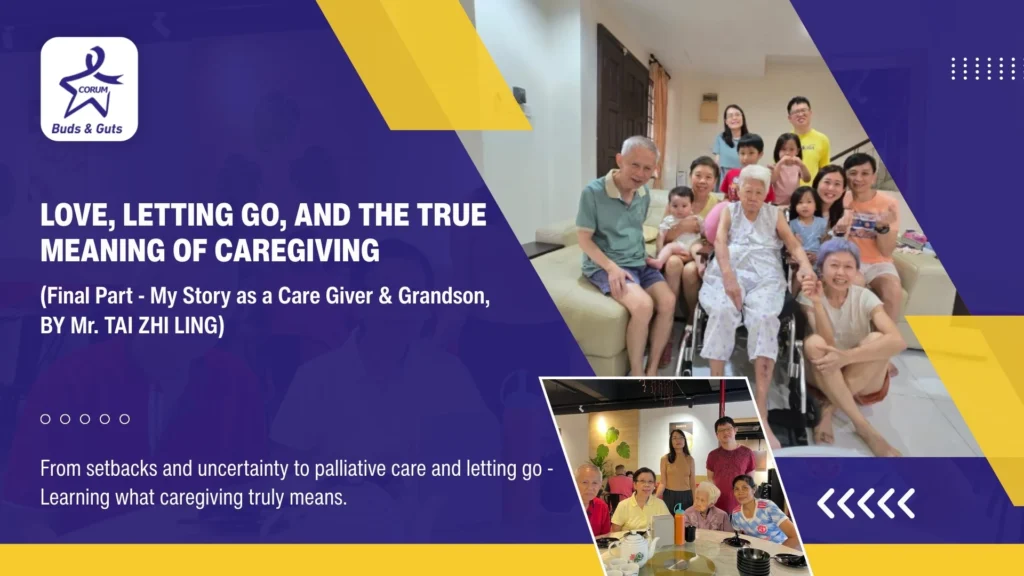
Decline, farewell, and the quiet heroism of loving someone to the very end.
After her hospitalization and the period of tube feeding, my grandmother’s condition improved noticeably.. She became stronger and more responsive. However, the IV drips from her hospital stay had caused some water retention in her arms. As the swelling subsided, she began experiencing intense itching on her arms and scalp. Moisturisers and creams did little to help. The itching worsened, and she scratched until the skin on her swollen arm broke. Fluid from the water retention began to ooze from the wounds, making them hard to heal. Within days, pus developed and spread across her arm; an infection had set in. We brought in a wound care nurse, but the situation did not improve, so we took her to a skin specialist. It was there that I began learning about wound care, how to chemically dry the wound, apply hydrogel, and use Vaseline during the scabbing phase to prevent tearing. The wound eventually healed, but her right hand never regained mobility. Looking back, I often wish I had possessed the knowledge of wound care earlier; perhaps she could still regain her hand mobility.
Finding the right person for the right job is incredibly difficult. It happened with stoma care, wound care and again when we sought a house-call physiotherapist for my grandmother. Unfortunately, the first physiotherapist did not tailor the therapy to her age and condition. It reached a breaking point when the therapist, who seemed to have a bad day, started to vent her frustrations on my grandmother by exerting more force than usual. It was heartbreaking to see my grandmother suffer in pain and agony, and at that point, we decided to let her go and look for a more suitable physiotherapist. Through word of mouth, we eventually found a geriatric physiotherapist who was far more experienced with elderly patients. I learned a lot from him, how to move my grandmother comfortably from wheelchair to bed, from bedside to car, and how to adjust her position safely. I realised there was so much to learn, yet so little time.
After the surgery, my grandmother was never quite the same. Her usually chatty, bubbly self became quiet and reserved. Before, I would listen to her stories and join in with laughter. After surgery, she spoke less and seemed distant. It saddened me deeply, but I was determined to always greet her with the brightest smile I could muster, no matter how bad the day was.
I told myself I couldn’t look sad; if I did, how would she feel? So I became the storyteller. I would chat, trying hard to remember all the stories she told me over the years, sing her favourite songs, and try to rekindle her spark. It wasn’t easy, but whenever she responded, even briefly, the joy was priceless. Her love for reading newspapers faded after surgery, as she could no longer read well. My mother began spending hours each day teaching her with preschool books. We celebrated every small victory for every word she managed to read, every witty answer she gave. Those moments of laughter and recognition were priceless. Many people believe that losing cognitive function or developing dementia means losing one’s identity. But through the years I spent with her, I realised that while memory and charisma may fade, love and care never do. Even when she forgot my name, she still reminded me to take an umbrella when it rained, not to get wet, small gestures that meant the world to me. Love doesn’t always need words; sometimes it’s felt through simple actions.
After a challenging first year filled with hospital visits and steep learning curves, my grandmother’s condition stabilised. She never returned to her pre-surgery self, but she was well enough that I could still have small conversations with her. Then, another challenge appeared. Our maid, who also helped care for my grandmother, contracted tuberculosis. Because tuberculosis is contagious and she slept in the same room as my grandmother, we feared the worst. Miraculously, my grandmother and the rest of the family tested negative, but I tested positive. Some might call it luck, but I believe there was a higher power watching over us. Life, as unpredictable as ever, when everything feels down, we have a pleasant surprise. After ten years of marriage, my wife became pregnant. My grandmother was thrilled to know she would soon meet her great-grandchild. Even with her fading memory, she always remembered that a baby was on the way, and her eyes lit up every time we spoke about it.
However, just as my wife was nearing delivery, my grandmother developed a fever. We brought her to the hospital, but on the way, she vomited and aspirated into her lungs, leading to pneumonia. The doctors at that time painted a grim picture. My heart broke; my wife had just gone into labour at the same time.
I told my grandmother that her great-grandchild was about to be born, and she should please wait a little longer. She was on oxygen, gasping for air. She asked, “Why is it taking so long?” I told her to wait a bit longer; your great-grandson will be born soon. With our prayers and her fighting spirit, she pulled through the infection. While she was hospitalized, my wife went through a difficult labour that ended in an emergency C-section. The next morning, with only a few hours of sleep, I rushed to show my grandmother a photo of her great-grandson. She looked at it and nodded. That simple gesture meant the world to me.
But the battle had taken a toll. The strong antibiotics damaged her kidneys, leading to kidney failure. She spoke less and grew weaker. Phlegm began building up in her throat, and she no longer had the strength to cough it out. We had to suction it regularly — a painful process for both of us. Even so, she still looked forward to seeing her great-grandson. She would ask, “Where’s the baby?” Those few words, though simple, showed that she remembered — and that she still cared.
When we brought her for follow-up at the geriatric clinic after the pneumonia episode, the doctor gave us devastating news. Her dementia had worsened, and she might only have months to live. He explained that as the disease progressed, she would eventually lose the ability to swallow or breathe, leading to death by starvation or suffocation. Hearing those words made my stomach turn. I couldn’t accept that my grandmother would have to leave this world in such a cruel way. The geriatrician didn’t recommend palliative care at first, but after repeated requests, we finally got a referral. That allowed her to stay home, away from exhausting hospital visits an hour away, which the geriatrician has no means to help her with anymore. By then, I knew her time was limited. I tried my best to give her my brightest smile every morning and accompany her as much as possible. I cooked her favourite food, BBQ meat with gravy, one of the dishes she used to make for me as a child. She couldn’t chew the meat anymore, but she savoured the gravy with joy. I knew my knowledge and strength were limited, but I promised myself that I would never leave her side. Even if everyone else gave up, I would stay with her until the very end.
Three weeks before my son’s first birthday, on 13 September 2025, my grandmother’s stoma suddenly started bleeding, with pus and necrotic tissue emitting a foul smell. Miss Wong, our usual stoma nurse, was away on vacation. Thankfully, I managed to contact Puan Mariam again, who helped connect us with another nurse for an urgent visit. It was a Sunday, and I frantically searched for a doctor willing to make a house call to start antibiotics. Thankfully, one agreed. After a two-day course of antibiotics, the bleeding stopped, and her stool returned to normal. I thought we were out of danger, but the higher power has other plans instead. On the morning of 17 September, during breakfast at 6 a.m., my grandmother passed away peacefully.
As I look back on this journey, I’ve come to understand the true meaning of being a caregiver. It literally means giving care to someone. It is not about performing all the tasks such as cleaning, feeding, bathing, but truly caring from the heart. Many see caregiving as a burden, something they wish would end quickly. But when you genuinely love the person, the work becomes second nature. There is no pay for this job, and you know, no matter what you do, the ending would still be the same. But that is where true care comes in. It is because you care for the person that you expect nothing in return. It is because you care that you choose to do whatever you can, however you can, until the very end. Doctors seek to cure the patient, but when that is no longer possible, it is up to the caregiver to care for them. My grandmother raised me from birth, when I was helpless and completely dependent on her. When she was diagnosed with cancer, I felt as though fate had given me the chance to return the care she once gave me. What I gave her may be only a drop in the ocean compared to all she gave me, but I am grateful for every moment we shared. I may not have been a trained nurse, but I gave her my love, my time, and my strength. I held her hand and whispered, “Everything is alright. Don’t worry — I’m here.” Even when my heart was breaking, I smiled for her. To me, that’s what being a caregiver truly means — not just cleaning, feeding, or nursing, but showing unconditional love, the way a mother cares for her child.
If someone asked whether I would do it all over again, my answer would be yes in a heartbeat. And I promise to do even better than I did today.
Grandma, thank you for the love and care you’ve given me throughout the years. Thank you for giving me the opportunity to care for you during your final journey. Even so, I know I can never repay what you’ve given me.
Grandma, I miss you.
Click here to read the first part of my story: The Day Cancer Entered Our Lives
Click here to read the second part of my story: Learning to Care, Learning to Survive