
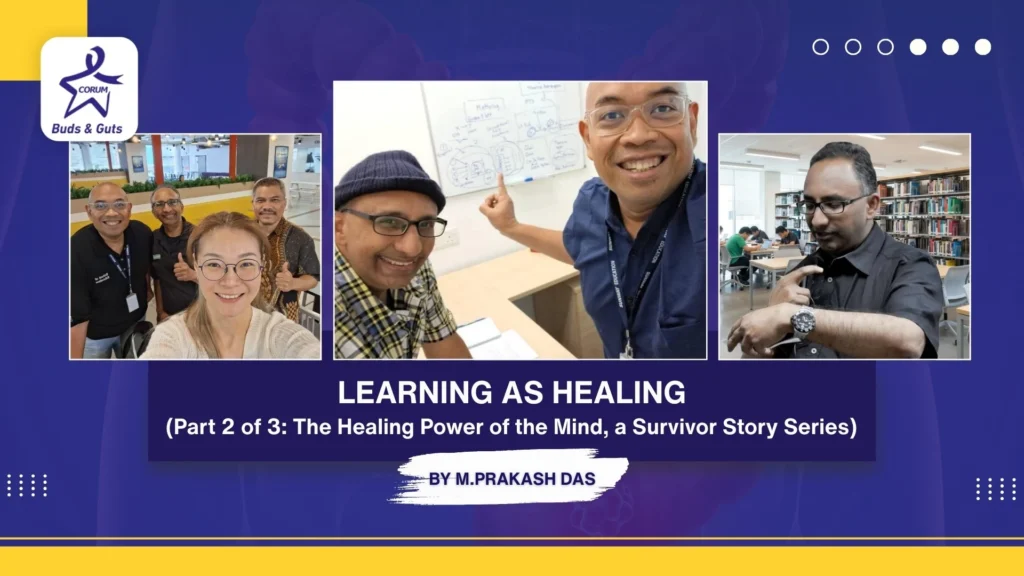
In Part 1, I shared how a cancer diagnosis at 62 transformed my life’s direction and led me to an unexpected decision – to return to university to pursue my second Masters degree in the midst of treatment. What began as a search for purpose during one of life’s darkest moments soon revealed itself to be far more profound. Learning was no longer just an intellectual pursuit; it became an anchor, a quiet force that steadied me through uncertainty. As I embarked on my studies, I discovered that education itself could serve as a form of therapy, one that nurtured not only the mind, but also the spirit yearning for renewal.
Stepping back into the world of academia after 40 years felt like stepping into a time capsule. So much had changed, the technology, the expectations, the way knowledge is delivered and shared. My first module was “Learning and Cognition,” an apt beginning because it centred on how people learn, remember, and think. As I dove into the materials and engaged with fellow learners, I realised that I was, in fact, applying these very principles to my own healing journey.
The human mind is a powerful instrument. It shapes perception, influences physiological responses, and helps us interpret pain, stress, and recovery. Through my coursework, I discovered how factors such as motivation, mindset, and emotional regulation directly impact how we learn, and by extension, how we heal. The more I studied, the more connections I saw between theory and life.
When I battled post-surgery fatigue or chemotherapy-induced nausea, I drew strength from cognitive theories that explained adaptation and neuroplasticity, the brain’s ability to rewire itself. Understanding this wasn’t just academic; it became personal. It reaffirmed that if the brain can adapt to learn new things, it can also adapt to bear pain, to find patterns of courage, and to create hope even when reality looks grim.
I considered my academic work an extension of my therapy. Every essay I wrote, every virtual discussion I joined, every reading I completed, it all represented small victories of discipline over despair. On days when my body felt weak, I told myself I could still be strong in my thoughts. My goal was not to earn grades but to train my mind to stay engaged and alive.
I adopted a mindset used by marathon runners – focusing not on the distance ahead, but on one step at a time. For me, that meant submitting one assignment or assessment paper, reading one journal article, or writing one reflective piece. These little steps, repeated with persistence, helped me regain a sense of progress in a life momentarily stalled by illness.
At times, the brain fog caused by medication made reading and writing slow. But instead of frustration, I saw it as an opportunity to practice patience, a virtue cancer teaches in abundance. I learned that even when our bodies change and slow down, our capacity to learn and to transform learning into healing, never fades.
One of the unexpected blessings of returning to study was the human connection it brought. My course-mates, most of whom were much younger than I, didn’t treat me differently. Instead, they welcomed me into discussions, respected my perspective, and often expressed curiosity about my journey, when they interacted with me in an individual basis. Their energy became contagious, reminding me of the vitality of youth and the promise of the future.
Even though the programme was conducted online, the bonds felt genuine. I discovered that learning isn’t just about individual achievement; it’s also a collective process that fosters empathy, understanding, and shared progress. My professors and the School of Education administrators were compassionate and encouraging. They ensured that students like me, managing both personal and academic challenges, felt supported.
Social interaction is a critical element in healing. Cancer can be an isolating experience, often driving patients inward. But studying pulled me outward. It pushed me to communicate, collaborate, and think critically with others. These interactions provided emotional warmth, mental stimulation, and a sense of belonging that no medical treatment can replicate.
As my journey through learning continued, I began to see that healing was not confined to the body or the intellect alone. It was a tapestry woven from many threads – perseverance, curiosity, connection, and self-belief. I also discovered that true recovery reaches beyond the classroom and the self. It blossoms in human connection – in shared energy, compassion, and faith. These realizations would lead me toward the next chapter of my journey – rediscovering purpose, faith, and renewal, something that I will touch upon in Part 3 of my reflection. Stay tuned!
Click here to read the first part of my story: THE HEALING POWER OF THE MIND