
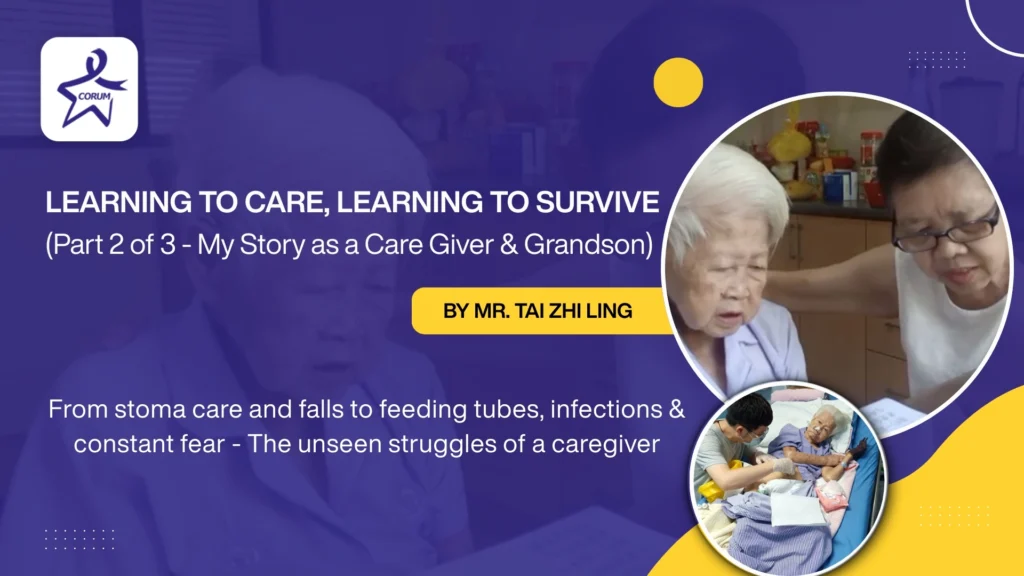
Upon discharge, I wheeled my grandmother to the car. Due to her weakness after surgery, she could not enter the car on her own. I do not have any prior knowledge of moving a bedridden patient. Lifting her from the wheelchair is like lifting multiple bags of rice. The effort to move her took all my strength, and at one point, I felt that I could not make it. Gritting my last bit of determination, I manage to move her into the car seat. With that hurdle out of the hurdle, I drove my grandmother slowly back home, going through the bumps as gently as possible. The following day, the stoma nurse made a house call. After inspecting my grandmother’s double-barreled stoma, she recommended a two-piece stoma bag. Since the bag is totally different compared to the ward, which is a one-piece solution, the cleaning and wafer change are totally different. After the first demonstration, she said she would come back the next day to make sure I was doing it right. But one day of training wasn’t enough. The next day, she inspected my technique, gave me a few pointers, and left. We asked her to return for a few more sessions, even offering to pay, but she declined.
With no choice, we searched for another stoma nurse willing to come before the following wafer change. The next nurse came and cut the wafer opening too big, causing stool to seep onto the raw skin, which became red and started to bleed. We could not reach that nurse anymore, so we sought another nurse for help. Another nurse came later, but the wafer was opened too roughly, resulting in lacerations on the stoma itself. The stress I felt was overwhelming. Seeing her raw skin inflamed and bleeding made me feel helpless. I didn’t know who to turn to or who to trust. Fortunately, through my father’s contacts, I reached out to Puan Mariam, an E.T. nurse, who connected me to Miss Wong. With Miss Wong’s guidance, I gradually gained the confidence and knowledge needed for proper stoma care. Without these two women, I don’t think I could have managed my grandmother’s stoma well.
During her recovery period, along with physiotherapy, she attempted to get back on her feet and walk. But unfortunately, she fell twice. We believed that she would be back to her old self, but we were mistaken. Seeing her bleeding on the floor, holding her on my lap, regret came flooding in. Why didn’t I stay with her in her room? Why didn’t I come faster when she got out of bed? Fortunately, despite the external injuries, there were no broken or fractured bones, something I thank my lucky stars for. We solemnly promise to look after her more attentively moving forward. My grandmother gradually recovered from the injuries, and for a while, we thought everything was fine. But sometimes, when life seems calm, it throws another curveball.
Gradually, my grandmother began eating less. Feeding her took hours, not minutes. Because she wasn’t eating much, she became lethargic and struggled to stay awake. Feeding her becomes more challenging. We try everything we can think of to keep her awake, singing to her, wheeling her from the kitchen to the living room, and then to the garden, to keep her awake and continue eating. We tried our very best to help her eat as much as she could. During this time, she lost significant weight, and her stoma shrank. Some areas of the skin surrounding the stoma sank inward, creating an uneven surface. This caused stool to seep through the edges of the wafer, irritating her skin and causing redness. With her limited mobility, it became harder to manage, but thankfully, Miss Wong, the stoma nurse, was there every step of the way, advising me on what to do. When she began complaining of pain throughout her body, it was the last straw. We brought her to the hospital for medical attention. Blood test revealed dehydration and hypercalcemia. The doctor recommended nasal feeding and IV drips. It felt like we had gone from the frying pan into the fire, barely recovering from surgery and now this.
The emotional roller coaster was unbearable, made worse by people around us saying she might die at any moment. Thankfully, after several days of nasal feeding and IV fluids, she started to feel better and was discharged after a week in the hospital. When she was ready for discharge, I was given a crash course in nasal feeding. I learned how to use the stethoscope to listen for bubbles in the stomach to confirm the tube’s placement, and how to slowly massage the syringe plunger to flush the water in, then follow with milk. It was stressful, especially when the water refused to go down during flushing. Together with the maid, we took turns feeding my grandmother. We never gave up hope that she would eat on her own again. We worked with an adult speech therapist who taught us massage techniques and exercises to stimulate swallowing. Before each meal, we faithfully followed the routine, feeding her small amounts of food by mouth alongside milk through her nasal tube. About a month into nasal feeding, the tube got stuck, and no water could flush in. We scrambled to find a nasal tube nurse to replace it, and we discovered that the food we had fed her alongside the milk had clogged the tube. At that point, we decided to stop the nasal tube and try feeding her orally again. It was a joyful moment when we saw her determination to swallow and drink milk without the feeding tube. For the next few weeks, she grew more vigorous and more alert; it felt like a calm before the next storm.
Click here to read the first part of my story: The Day Cancer Entered Our Lives